

FieldLink.
Remote access to devices in the field: secure, controlled and recorded. One approved engineer reaches one device, for a set time, and nothing opens on the site's firewall.
Every way in today costs something
-
A VPN into the site
Wide access, often left open, and hard to tie to one person and one reason.
-
A port opened in the firewall
Anyone on the internet can knock, and the site's IT team has to agree to it.
-
Someone drives there
Hours on the road for a change that takes five minutes.
FieldLink fixes all three. One approved engineer reaches one device, nothing opens on the site's firewall, and the five minute change takes five minutes.
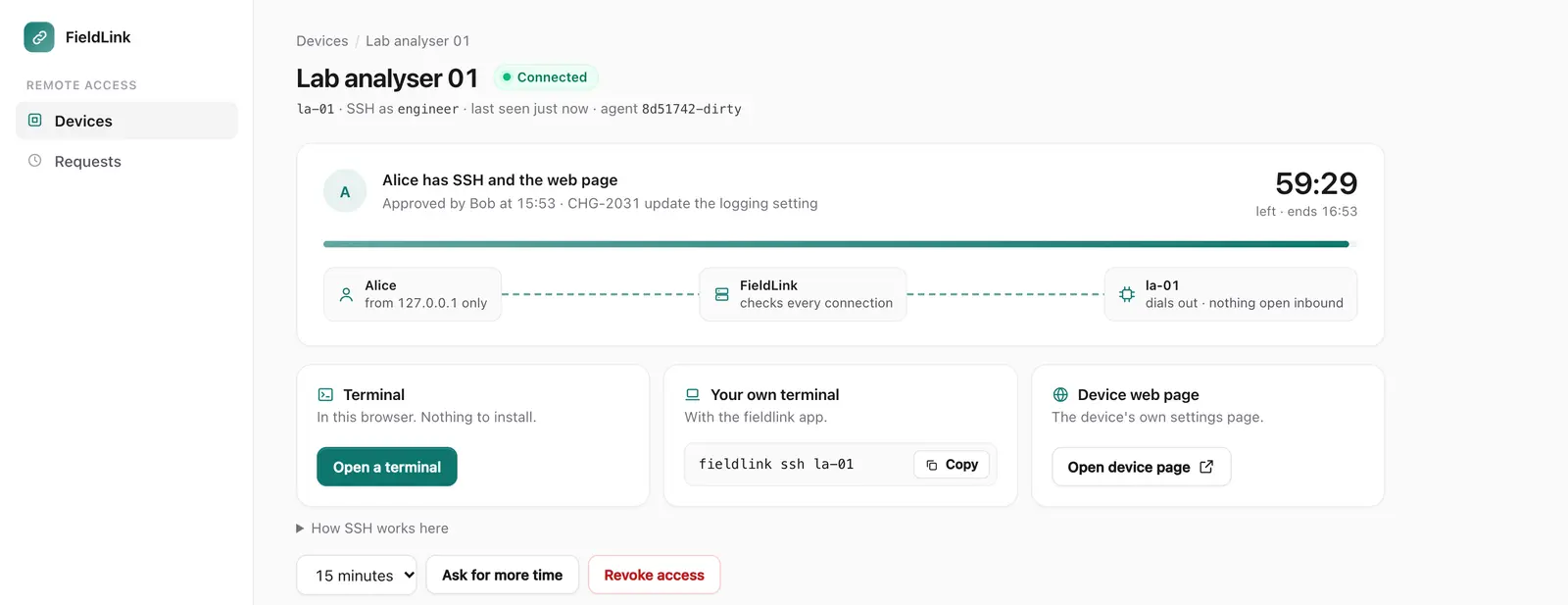
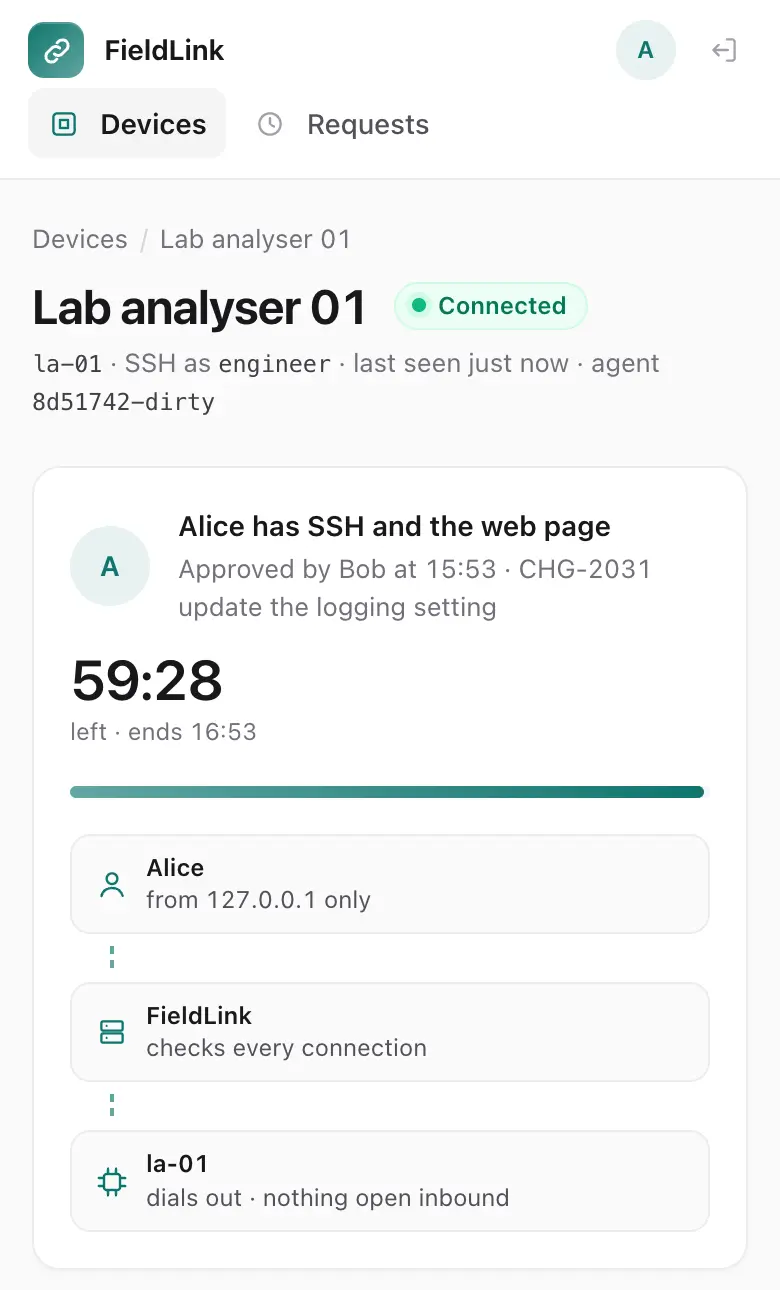
The device calls out. Nothing calls in.
Engineer
Two step sign in. Asks for access, with a reason.
FieldLink
Checks the person, the approved grant and their internet address, on every connection.
Device
Dials out on port 443, like a web browser. No port opened on its firewall.
The site's network needs no change. If the device can reach a web page, it can reach FieldLink.
Ask, approve, connect
- Ask. An engineer asks for a terminal or the device's own web page, for a set time, with a reason.
- Approve. Someone else approves it. Nobody can approve their own request, and the rule lives in the server's settings file, so a stolen login cannot switch it off.
- Connect. The device connects within seconds, and the line closes when the time is up. More time is asked for and approved the same way.
Two ways in
- A terminal in the browser. One button on the device page. Any laptop, Windows included, with nothing to install.
- The
fieldlinkapp. For engineers who want their own tools. It fetches a short lived SSH certificate for the grant and hands it to their own ssh, so scp, rsync and VS Code work as normal.
Every login uses a certificate made for that grant, that one device and its engineer account, never root. The device refuses it once the grant ends, even if it cannot reach FieldLink. Nothing is left behind to remove when someone leaves or loses a laptop.
What it looks like

Revoke means now
0.28 s
From pressing Revoke to an open SSH session closing, round trip included. Measured on 28 October 2026 on the FieldLink demo server. It is not a timeout or a poll: the line is cut the moment the revoke is saved.
Everything is on the record
Who asked, why, who approved, every connection and every certificate. Each entry is chained to the one before, so an edited or removed entry shows. fieldlink audit verify checks the chain end to end.
What is in the box
-
Access
- Ask with a reason
- Someone else approves
- More time on request
- Revoke in under a second
-
Ways in
- A terminal in the browser
- The fieldlink app, for your own tools
- The device's own web page
- The portal on a phone
-
Safety
- Two step sign in
- A certificate per grant
- Locked to one IP address
- The device only dials out
- Encrypted throughout
-
Running it
- Your server or mine
- Your name, logo and colour
- One script per new device
- A record that shows any edit
Where it runs
On your own server by default, closed networks included. Or on a server I run just for you, in an AWS or Hetzner data centre. It is never a shared service: your devices and your records sit on a server that is only yours.
It carries your name, logo and colour, so your customers' IT teams see your product. A new device needs one install script and a pairing token from the portal. A small agent runs on the device, and your firmware stays yours.
FieldLink is made by Infinity Loop Limited, the company I trade as.
See it working
Twenty minutes, live, on a test device. One engineer asks, someone else approves, the engineer works on the device through a closed firewall, then access is revoked and we read back the record.